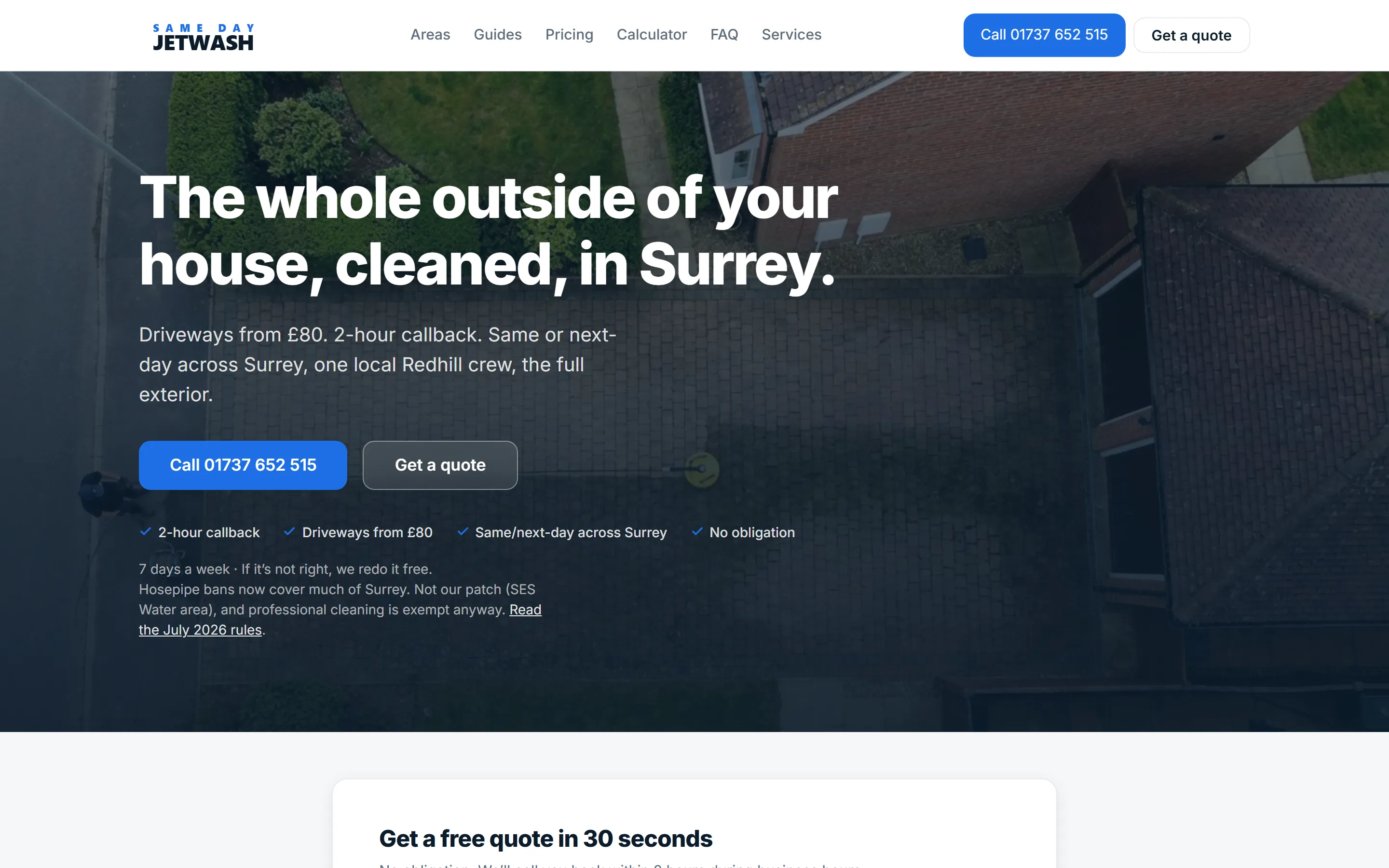
Sameday Jetwash is a booking service the founder runs; it passes each enquiry to an independent local exterior cleaning business, which quotes and does the work. It covers Surrey within 20 miles of Redhill (RH1). We do not do the cleaning. We built the website and we run it.
We put that first because it changes how you should read this page. This is not an arm’s-length client engagement, and we will not dress it up as one. The site is our own, and that is precisely why we can do something here that client confidentiality normally prevents: publish the site’s unedited Google Search Console data, the good lines and the less flattering ones, with every number traceable to a raw export.
Read it as a demonstration of how we work when nobody is marking our homework.
What we built
This was a new build, not a rescue. We built samedayjetwash.com from scratch: the first version was committed on 15 December 2025 as a static site, and it moved onto its own domain on 25 January 2026. It was run deliberately to the same shape we sell to paying clients, because the whole value of an in-house proving ground is that it gets no special treatment.
That shape is a page for each service, from driveways and patios to render, roofs, gutters and solar panels, and a page for each town the booking service covers. Prices sit on the page rather than behind a callback, a quote form emails each enquiry straight in, and the guides answer the questions people type before they book. The service and town pages were the plan. The guides turned out to matter most.
What happened: the unedited numbers
The stat tiles and the chart further up this page come straight from the Search Console exports for the 90 days to 11 August 2026, compared with the 90 days before.
Clicks grew from 125 to 9,126 in 90 days. Impressions grew from 42,341 to 607,005 over the same 90 days. The site’s average search position improved from 28.8 to 12.8, and click-through rate rose from 0.3 per cent to 1.5 per cent. The number of pages earning at least one click grew from 35 to 75, and 138 pages earned at least one impression. The export lists 173 addresses, because Google also counts links that jump to a section inside a page; we count each page once. Daily clicks first passed 100 on 3 July 2026 and peaked at 588 on 21 July 2026.
One footnote we would rather volunteer than have you find: Google’s per-page export and its per-day export disagree slightly, 9,126 clicks against 9,121. Both are Google’s own figures for the same window. We quote the page export; the daily chart and its table sum to the daily one.
Where the clicks came from, and why we are proud of it
Two hosepipe-ban guides earned 8,423 of those 9,126 clicks, 92.3 per cent of the total. The single biggest search behind the spike was “ses water hosepipe ban”, which sent 630 clicks. We are not burying that in a footnote; it is the most useful thing on this page.
Here is what actually happened. When the drought restrictions landed in Surrey, where the booking service works, we wrote two guides answering the questions people were actually typing: whether there is a hosepipe ban in Surrey, and what a pressure-washing customer can and cannot do under one. Both went live on 2 July 2026; in the previous 90 days neither existed. On 30 June the whole site took 10 clicks; on 2 July, 66; on 3 July, 117. Across the window the two guides averaged positions of 5.3 and 4.9, and across the five biggest hosepipe searches our average positions ran from 3.0 to 6.1.
That is the repeatable part: we watched the market the booking service works in, published a useful answer while it still mattered, and the site’s clicks jumped the day the guides went live. The spike itself is weather. The reflex is the method.
The commercial engine underneath
Strip the hosepipe spike out entirely and the picture underneath still moved: excluding the hosepipe guides, the rest of the site grew from 125 clicks to 703 clicks, a 5.6 times increase.
Most of that engine is the cost guides, the pages that answer “what does this cost” for each service. Same 90-day comparison, previous period first. Where a guide also ran at a legacy .html address in the previous period, those clicks are included so the growth is not overstated:
- Block paving cleaning cost guide: 24 clicks to 105, average position 6.3 to 7.1
- Patio cleaning cost guide: 15 clicks to 55, average position 9.4 to 11
- Roof cleaning cost guide: 1 click to 37, average position 17.1 to 13.7
- Weed removal guide: 1 click to 66, average position 24.6 to 11.7
- Tarmac driveway cleaning guide: 4 clicks to 29, average position 16.7 to 13.6
- Pressure-washing cost calculator: 6 clicks to 43, average position 37.9 to 33.5
- UK pressure-washing statistics page: 4 clicks to 37, average position 5.9 to 9.3
The pages that started deep climbed hard: the weed removal guide from position 24.6 to 11.7, the roof cleaning guide from 17.1 to 13.7. And we publish the wobbles too. Three of the seven slipped in average position even as clicks grew: the block paving guide from 6.3 to 7.1, the patio guide from 9.4 to 11, the statistics page from 5.9 to 9.3. A results page you can trust has to include the lines that flatter us less.
What this buys you as a client
The transferable asset is not 9,126 clicks. We will not promise you 9,126 clicks, and we would be wary of anyone who does; a spike like July’s needs a drought, two fast guides and a bit of luck to line up at once. Saying so plainly is, we think, the strongest trust signal on this page. What transfers is the method that produced all of it:
- Watching the market the business actually serves, and publishing a genuinely useful answer fast when something changes
- Cost guides and service pages that answer the questions buyers type, one page per service, one per town
- Technical hygiene: a fast static build, clean indexing, structured data, and a Google Business Profile that is verified and current
- Numbers reported from the source exports, not from a marketing deck
If we take you on, that is the work you are buying. The honest version of the promise is that we will do the same things, measure them the same way, and show you the same exports.
How it runs month to month
The site runs on the same playbook we sell as the Growth plan: small copy edits, new pages when the business expands its reach, and a monthly look at the Search Console numbers. Because it is ours, we also use it to try page structures, schema changes and guide formats on our own traffic before we use them on a client site.
If you run a small UK trade business, one or two people with a van or a unit, whose customers find you through search, the work for you is a 30-minute brief, a draft within two working days, live in about a week, then a monthly retainer that keeps the site current without you having to think about it. The price band is published openly on the pricing page, and what is included in each tier is on the services page.